
Settling into the Present Moment Meditation
When life feels busy or overwhelming, presence offers a place to return. This guided mindfulness meditation gently invites you to slow down, breathe, and fully arrive in the here and now. Through simple awareness practices, you'll cultivate greater calm and steadiness. Leave feeling grounded, refreshed, and connected to the present moment. This meditation is 11 minutes long and was written and narrated by Eden Sipperly, Licensed Clinical Mental Health Counselor Associate and Reiki Master Teacher.
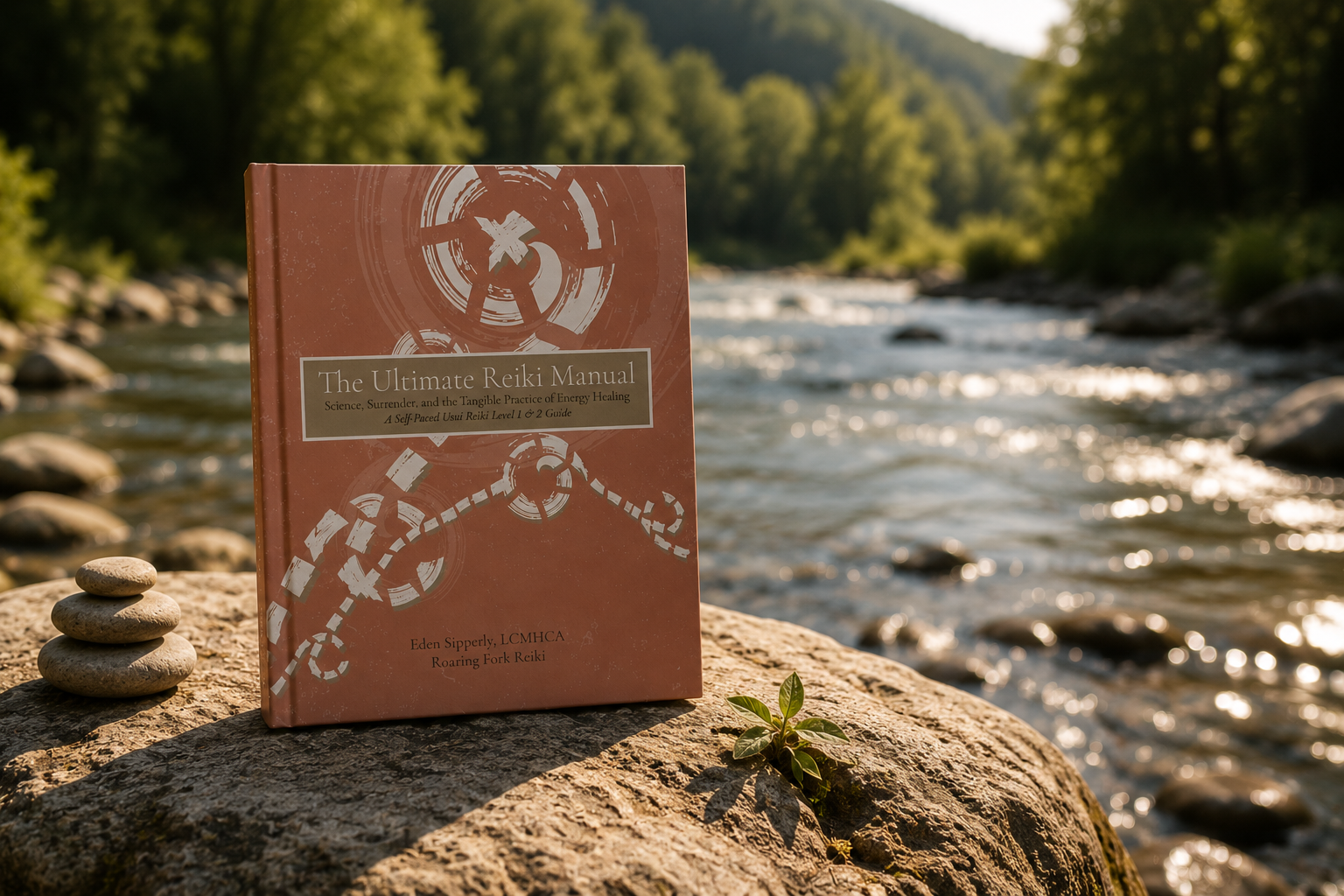
Weekend Reiki Training or Self-Paced Study? Choosing a Reiki Training That Gives You Time to Integrate
Weekend Reiki Training or Self-Paced Study? Choosing a Reiki Training That Gives You Time to Integrate
There is something appealing about the idea of learning Reiki in a weekend.
You arrive on Saturday curious about energy healing. You spend two days learning the history, hand positions, symbols, principles, and practices of Reiki. You receive your attunement. By Sunday evening, you leave with a certificate.
For some people, that experience is exactly what they are looking for.
But when I began creating The Ultimate Reiki Manual: A Self-Paced Usui Reiki Level 1 and 2 Guide for You to Explore Science, Surrender, and the Tangible Art of Energy Healing, I kept wondering:
What if Reiki training didn't need to happen so quickly?
What if instead of asking you to absorb an entirely new way of noticing yourself, your body, your intuition, and other people within a weekend, you were given permission to take your time?
To read something.
Practice it.
Question it.
Meditate with it.
Live your life for a few days.
And then come back.
That is the kind of Reiki training I wanted to create.
The Cost of Reiki Training Can Add Up Quickly
Traditional in-person Reiki training can be a wonderful experience, particularly when you find a teacher whose philosophy resonates with you.
It can also become expensive.
Depending on the practitioner, location, class size, and training structure, Reiki Level 1 and Level 2 are often offered as separate courses, meaning you're paying tuition each time you advance. Add travel, accommodations, meals, childcare, time away from work, or additional required materials, and the actual cost of certification may extend well beyond the advertised class price.
Online Reiki courses can sit at the opposite end of the spectrum. Some are remarkably inexpensive, but the tradeoff may be a shorter curriculum, limited experiential practice, little discussion of ethics or contraindications, and minimal access to the teacher once you've purchased the course.
I wanted to create something in the middle:
an accessible self-paced training without sacrificing depth.
Rather than paying separately for multiple levels or compressing your education into a weekend, The Ultimate Reiki Manual includes the foundational education for Usui Reiki Levels 1 and 2 within one comprehensive resource, alongside experiential practices, case studies, scientific exploration, practitioner development, and opportunities for integration.
And the book remains yours.
You can return to it months—or years—after certification.
More Hours Doesn't Automatically Mean More Learning
There is an important difference between being exposed to information and integrating information.
Imagine someone teaching you fifty new yoga poses on Saturday.
Technically, you may have been introduced to all fifty.
But have you learned them?
Probably not.
Your body hasn't had enough experience with them yet.
Reiki can be similar.
A weekend training may introduce you to meditation, energetic anatomy, Reiki history, hand positions, symbols, intuition, ethics, client sessions, and spiritual concepts in rapid succession.
That can be beautiful.
It can also be a lot.
Particularly when some of the material isn't simply asking you to remember information.
It is asking you to experience something.
Integration Requires Space
Our brains consolidate learning over time.
Practice, repetition, reflection, rest, and returning to material can all contribute to how deeply something becomes understood rather than simply remembered long enough to complete a course.
This is particularly relevant to Reiki because so much of the practice involves internal awareness.
You might complete a meditation on intuition today and feel almost nothing.
Then you repeat it next week and notice a sensation in your chest.
You practice again a month later and realize you have begun recognizing that same sensation in everyday life.
That progression matters.
It cannot necessarily be rushed.
Sometimes learning Reiki is less like downloading information and more like steeping tea.
The ingredients may all be present from the beginning.
But they need time in the water.
50+ Meditations You Don't Have to Rush Through
One of the foundations of The Ultimate Reiki Manual is its library of more than 50 guided meditations and experiential practices.
These aren't included simply to help you relax.
They are designed to help you actively explore intuition, embodiment, energetic awareness, energy channels, visualization, mental steadiness, self-inquiry, and your developing Reiki practice.
And because your training is self-paced, you don't need to rush through them.
You could repeat the same meditation for a week.
You could pause halfway through a chapter because something brought up an interesting question.
You could spend a month practicing Reiki on yourself before moving forward.
You could return to a meditation six months later and notice that your experience has completely changed.
There is no prize for finishing quickly.
The practice itself is the point.
You Have Time to Discover What Intuition Feels Like for You
Intuition is one of the areas where I particularly value slower learning.
It is easy to tell someone:
"Trust your intuition."
It takes considerably more practice to understand what that actually means.
What does intuition feel like in your body?
How is it different from anxiety?
How do imagination, memory, emotion, and expectation influence what you perceive?
What happens when you don't receive any information?
What happens when you interpret something incorrectly?
Rather than teaching you what intuition is supposed to feel like, the manual repeatedly brings you back into direct experience so you can begin developing your own vocabulary for it.
Think about learning the subtle flavors in coffee or wine.
At first, you might simply taste coffee.
But after repeatedly slowing down and paying attention, differences begin emerging.
Acidity.
Sweetness.
Bitterness.
Fruit.
Chocolate.
Earth.
The information may have been present all along.
Practice changed your ability to perceive it.
Intuition can develop similarly.
A Much Bigger Conversation Than Hand Positions
Of course, you'll learn the Reiki essentials.
The Ultimate Reiki Manual covers Usui Reiki history and philosophy, prayers, hand positions, Reiki symbols, attunement, energetic anatomy, chakras, and other foundational knowledge expected within Reiki Level 1 and Level 2 education.
But I wanted the training to go further.
Because if you are eventually going to place your hands on another person, I believe you should understand more than where your hands go.
The manual also explores the nervous system, trauma-informed care, ethics, contraindications, boundaries, consent, business practices, scientific theories relevant to energy work, neuroscience, intuition, embodiment, and quantum physics.
It includes 40+ case studies based on real-life client experiences, helping you consider how the ideas you're learning might actually present themselves during a Reiki session.
You'll also find journal prompts, inspirational quotes, reflection pages, and invitations to question your own beliefs throughout the training.
The goal isn't simply:
Learn Reiki.
It is:
Become someone who can practice Reiki thoughtfully.
Self-Paced Doesn't Mean You're Doing It Alone
This was especially important to me.
One of the biggest advantages of an in-person Reiki training is access to a teacher.
You can ask questions.
You can talk about an unusual meditation experience.
You can say, "I don't understand this."
Or, "I think I felt something, but I'm not sure what it was."
I didn't want choosing a self-paced Reiki training to mean losing that human element.
That's why completion of my manual includes an opportunity for one-on-one support with me.
After you've had time to actually work with the material, we can connect.
You can bring questions from your training, discuss experiences that arose during your meditations and Reiki practice, explore areas where you feel less confident, and receive support around what continuing your practice might look like.
In some ways, I love that this conversation happens after you've spent meaningful time with the material.
Instead of trying to anticipate your questions before you've practiced, you get to bring questions that emerged because you did.
You Can Learn Around Your Actual Life
There is another very practical benefit to self-paced Reiki training:
Your life doesn't have to stop.
You don't necessarily need to find childcare for an entire weekend.
You don't need to take off work.
You don't need to travel.
You don't need to be energetically receptive from 9 a.m. until 5 p.m. simply because that is when the course is scheduled.
You can learn when you have the capacity to learn.
Read twenty pages on a Sunday morning.
Try a meditation before bed.
Practice Reiki on yourself after a difficult day.
Take a week away from the material.
Return when you're curious again.
There is something very aligned about learning a practice centered around presence without forcing yourself through the learning process.
Your Manual Becomes a Resource After Certification
One of my favorite things about learning from a physical manual is that certification isn't the end of your relationship with the material.
Imagine you've been practicing Reiki for six months and suddenly encounter a situation that makes you question a boundary.
Go back to the ethics section.
You're feeling disconnected from your intuition.
Return to one of the meditations.
You're preparing to offer sessions professionally.
Revisit the business chapters.
You can't remember a symbol.
It's there.
Your manual can become marked up, highlighted, dog-eared, journaled in, and returned to as your practice evolves.
The book you begin as a student can eventually become the book sitting beside you as a practitioner.
I love that.
Who Is This Kind of Reiki Training For?
This manual may be especially useful if you are someone who wants to understand the why alongside the how.
Someone who wants room for both spirituality and skepticism.
Someone interested in nervous system regulation, science, psychology, embodiment, intuition, and energy.
Someone who wants to practice rather than simply memorize.
Someone who prefers to absorb information slowly.
Someone who wants to ask difficult questions about ethics and boundaries.
Someone who wants Reiki for personal healing and self-practice.
Or someone who can imagine eventually sharing Reiki with friends, family, existing clients where appropriate, or building a Reiki practice of their own.
You don't need to know which direction you're heading when you begin.
You simply need somewhere thoughtful to begin exploring.
There Is No Rush to Become a Practitioner
Perhaps this is the philosophy underneath the entire book.
There is no hurry.
You do not need to become intuitive overnight.
You do not need to understand every energetic sensation.
You don't need to finish your training in two days simply because you can.
You are learning to pay attention to something subtle.
And subtle things become easier to perceive when we stop rushing past them.
The Ultimate Reiki Manual was designed to give you that time.
Time to understand.
Time to question.
Time to meditate.
Time to practice.
Time to integrate.
Time to notice your own nervous system.
Time to develop your unique relationship with intuition and energy.
And, when you're ready, the opportunity to sit down with me one-on-one and talk about what you discovered along the way.
Because Reiki certification can happen relatively quickly.
Becoming the practitioner you want to be is allowed to take longer.

5 Senses Meditation
Reconnect with the present moment by awakening each of your five senses through mindful awareness. This grounding meditation gently shifts attention away from racing thoughts and back into your immediate experience. By engaging sight, sound, touch, smell, and taste, you'll cultivate calm, clarity, and presence. An excellent practice for reducing anxiety and reconnecting with your surroundings. This meditation is 11 minutes long and was written and narrated by Eden Sipperly, Licensed Clinical Mental Health Counselor Associate and Reiki Master Teacher.
Tracing Back Your Lineage Meditation
This guided meditation offers space to reflect on the generations that came before you and the stories that continue through your life. With compassion and curiosity, you'll explore your connection to family, ancestry, and the resilience carried through your lineage. Whether approached symbolically or personally, this practice invites gratitude and perspective. Return with a deeper appreciation for your place within a larger story. This meditation is 11 minutes long and was written and narrated by Eden Sipperly, Licensed Clinical Mental Health Counselor Associate and Reiki Master Teacher.

Alternate Nostril Breathing: Intermediate Meditation
Take the next step in your breathwork journey with this intermediate alternate nostril breathing practice. Designed for those comfortable with the basics, this meditation helps balance the nervous system while improving focus and mental clarity. Gentle guidance allows you to deepen your relationship with the breath at a comfortable pace. A wonderful daily practice for grounding and emotional balance. This meditation is 6 minutes long and was written and narrated by Eden Sipperly, Licensed Clinical Mental Health Counselor Associate and Reiki Master Teacher.

Chakra Unification Meditation
Rather than experiencing your energy centers as separate, this meditation invites you to sense them working together as one integrated system. Through visualization and mindful awareness, you'll cultivate harmony, balance, and connection throughout the body. This practice supports both energetic alignment and emotional wellbeing. Return with a renewed sense of wholeness and inner coherence. This meditation is 6 minutes long and was written and narrated by Eden Sipperly, Licensed Clinical Mental Health Counselor Associate and Reiki Master Teacher.

The Nervous System Is Listening: How Co-Regulation Works in Reiki
The Nervous System Is Listening: How Co-Regulation Works in Reiki
There is something profoundly different about being calm alone and being calm in the presence of another person.
You may have experienced this without having language for it. Maybe you were overwhelmed and someone sat beside you without trying to fix anything. Maybe you cried while a friend quietly held your hand. Maybe you walked into a room carrying a frantic mind and tight shoulders, only to notice that after twenty minutes with someone who felt grounded, you were breathing differently.
Your body was paying attention.
This is part of what psychology and neuroscience describe as co-regulation: the ways our nervous systems respond to cues of safety, steadiness, connection, and threat within other people and our environment.
And it is one of the lenses through which I understand what can happen during Reiki.
We Were Never Designed to Regulate Entirely Alone
We often talk about nervous system regulation as though it is an individual skill.
Take a deep breath. Meditate. Go for a walk. Journal. Ground yourself.
These practices can absolutely help. But human nervous systems developed within relationship. Before we could regulate ourselves, we were regulated by others.
Think about an infant.
A baby does not understand that their racing heart will eventually slow down. They don't know that hunger will pass or that an unfamiliar sound isn't dangerous. Instead, they borrow information from the nervous systems around them: the rhythm of a caregiver's breathing, the warmth of their body, their facial expressions, their voice, their touch.
Over time, these repeated experiences help teach the developing nervous system something incredibly important:
I can become activated, and I can return.
We continue doing versions of this throughout adulthood.
Our bodies are constantly gathering information from other bodies. Tone of voice, facial expression, posture, movement, predictability, proximity, and touch can all contribute to our perception of safety or threat.
This means regulation can be contagious.
Unfortunately, dysregulation can be, too.
Your Nervous System Is Always Gathering Data
Imagine walking into a room where two people have just had an argument.
Nobody tells you what happened. They may even insist that everything is fine.
And yet—you can often feel that something is off.
There are perfectly ordinary physiological explanations for at least part of this experience. Human beings are remarkably sensitive to subtle social information: changes in facial expression, muscular tension, vocal tone, breathing, movement, attention, and interpersonal behavior.
We are continually making predictions about whether our environment is safe enough to soften within.
This is one reason being around a deeply anxious person can sometimes make us feel more activated ourselves. It is also why being around someone who feels genuinely grounded—not artificially cheerful, but present—can allow something inside us to settle.
In Reiki, I think this matters tremendously.
Reiki as a Practice of Co-Regulation
Reiki is often described primarily in terms of energy: a practitioner places their hands on or near the body with the intention of facilitating balance, relaxation, and healing.
I don't think we have to abandon that framework to also become curious about what is happening through the nervous system.
A Reiki practitioner spends considerable time practicing presence.
We meditate. We become aware of our breathing. We notice sensation. We practice nonjudgment. We learn to sit beside discomfort without immediately trying to change it. We intentionally slow ourselves down before placing our hands on another human being.
In other words, many of the practices that prepare someone to offer Reiki are also practices associated with cultivating regulation, interoceptive awareness, and embodied presence.
So imagine arriving for Reiki after a week of anxiety.
Your thoughts have been moving quickly. Your shoulders are hovering somewhere near your ears. Your breathing has become shallow without you noticing it.
Then you enter a quiet room.
Nothing is required of you.
There is no problem you need to solve. There is no conversation you need to perform correctly. Someone nearby is breathing slowly, moving intentionally, and offering their attention without demanding yours.
Your nervous system begins receiving different information.
Maybe I don't have to be on guard right now.
And slowly, perhaps, the body experiments with letting go.
Regulation Isn't the Same as Being Calm
This distinction is particularly important.
A regulated nervous system is not a nervous system that never becomes anxious, angry, overwhelmed, or grief-stricken.
Regulation is flexibility.
It is our capacity to move through different states and eventually find our way back.
This matters because Reiki isn't about asking someone to become peaceful when their body has a very legitimate reason not to be.
If you are grieving, regulation may include crying.
If you have been chronically overwhelmed, regulation may initially look like realizing how exhausted you actually are.
If you have spent years disconnected from your body, becoming more regulated might temporarily mean noticing sensations and emotions that were previously outside your awareness.
Sometimes healing doesn't feel like floating.
Sometimes it feels like finally having enough safety to feel what was already there.
Can Another Person Actually "Rewire" Your Nervous System?
This is where I like to be careful with language.
One Reiki session isn't likely to magically reprogram your nervous system. Neuroplasticity—the brain and nervous system's capacity to adapt through experience—is generally shaped through repetition.
But that is precisely what makes experiences of safety meaningful.
Every time your nervous system encounters activation followed by a safe return, it receives new information.
Every time you experience closeness without danger, stillness without something going wrong, or touch without expectation, the nervous system has an opportunity to update its predictions.
Think of walking through a field.
The first time you cross it, there may barely be a path.
Walk the same route repeatedly, and the grass begins to bend beneath your feet. Eventually, a trail emerges.
Our nervous systems are far more complicated than a field, of course, but I love this metaphor for neuroplasticity. Repeated experiences make certain responses increasingly familiar and accessible.
A Reiki session can become one more experience of walking the path toward safety.
Over time, the body may become better acquainted with the route.
What About Grief?
Grief offers a particularly beautiful example because grief is not something that needs to be regulated away.
There is nothing pathological about a nervous system responding intensely to loss.
Sometimes what a grieving person needs most is not advice, reframing, or another attempt to make meaning from something that does not yet make sense.
Sometimes they need another regulated human being willing to sit beside what cannot be fixed.
This is something Reiki can offer exceptionally well.
There does not need to be a conversation.
There does not need to be a breakthrough.
There can simply be another person communicating, through their presence:
You don't have to leave this feeling for me to stay here.
That experience itself can be regulating.
Perhaps This Is Part of What We Call "Energy"
Science does not currently provide us with a complete explanation for every claim made about Reiki, and I think there is integrity in saying that plainly.
But I also don't believe uncertainty requires dismissal.
Humans have used words like energy, presence, vibe, intuition, and connection for a very long time to describe information that we experience before we necessarily understand its mechanism.
Sometimes science eventually gives us new language for pieces of those experiences.
Co-regulation gives us one such language.
It reminds us that what happens between two people is not merely psychological. Relationship can be physiological. Presence can be embodied. Safety can be communicated without a sentence being spoken.
Perhaps Reiki gives us a structured practice for paying very close attention to that space between people.
Not forcing.
Not fixing.
Not promising that every difficult feeling will disappear.
Simply practicing what it means to become steady enough that another nervous system might remember, even briefly, what steadiness feels like.
And sometimes, that is where something begins to shift.
Circuit Breath Meditation
Experience the flow of breath and awareness through this guided circuit breathing meditation. Using visualization alongside intentional breathing, you'll explore the feeling of energy moving throughout the body. This calming practice supports focus, nervous system regulation, and embodied presence. Leave feeling balanced, refreshed, and deeply connected to your breath. This meditation is 12 minutes long and was written and narrated by Eden Sipperly, Licensed Clinical Mental Health Counselor Associate and Reiki Master Teacher.
Recognizing Self as Vibration Meditation
Explore your relationship with energy, breath, and awareness through this contemplative guided meditation. Drawing on both mindful observation and energetic imagination, you'll reflect on the interconnected nature of your physical and energetic experience. This practice encourages curiosity, presence, and a greater sense of connection with yourself. Leave feeling grounded while expanding your awareness. This meditation is 13 minutes long and was written and narrated by Eden Sipperly, Licensed Clinical Mental Health Counselor Associate and Reiki Master Teacher.
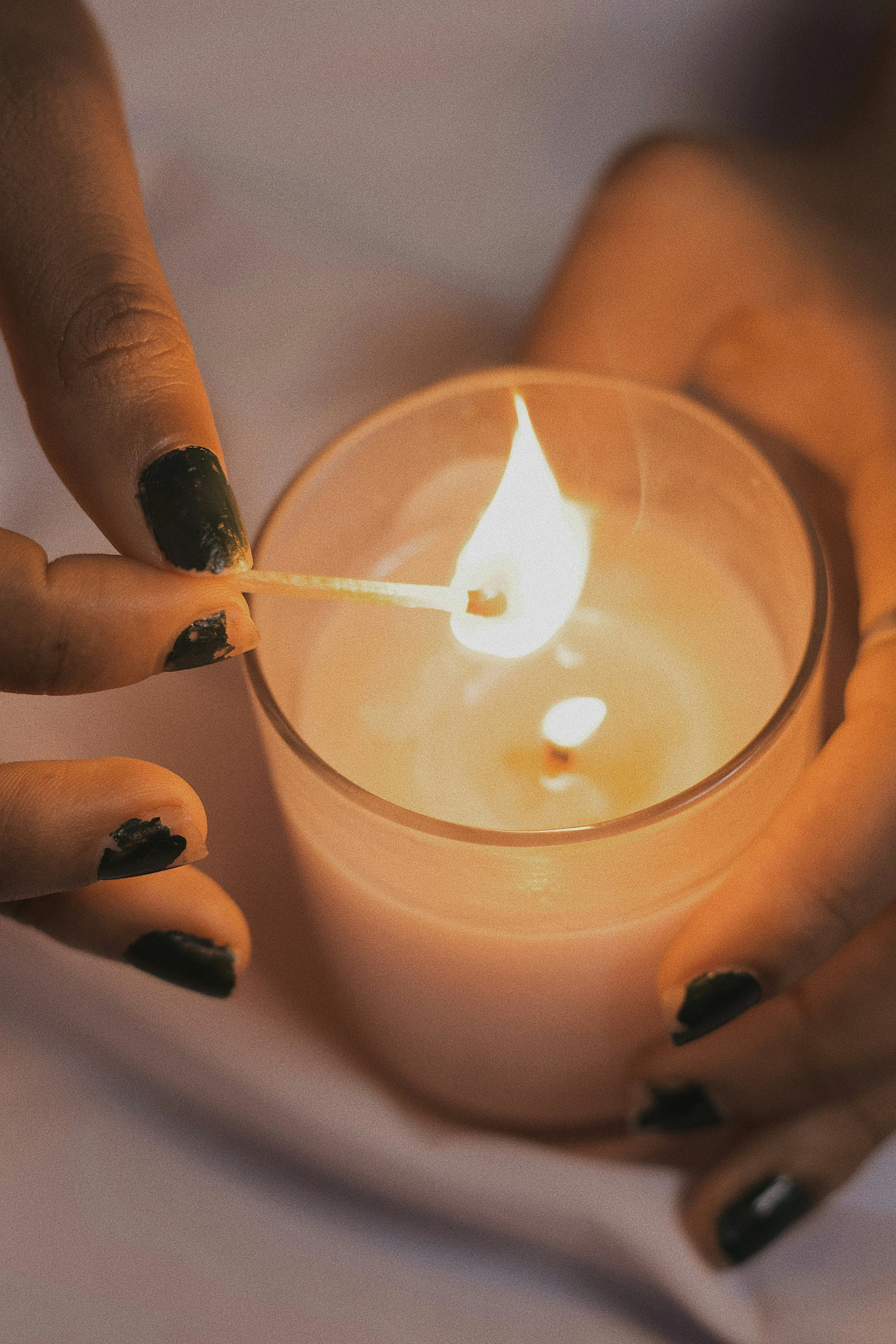
A Practice of Accepting Change: Candle Gazing Meditation
Discover the calming power of candle gazing in this meditation centered on embracing change. Using the steady flame as an anchor for attention, you'll practice remaining present with the natural movement of life. This mindfulness exercise encourages acceptance, focus, and emotional flexibility. A peaceful practice for cultivating resilience during seasons of transition. This meditation is 22 minutes long and was written and narrated by Eden Sipperly, Licensed Clinical Mental Health Counselor Associate and Reiki Master Teacher.

Receiving Your Intuitive Yes and No’s Meditation
Your intuition often communicates through subtle sensations before words ever arise. This guided meditation helps you become more aware of the physical and emotional signals associated with your internal yes and no. Through gentle exploration, you'll strengthen trust in your own inner guidance. Leave feeling more confident in recognizing your intuitive responses. This meditation is 12 minutes long and was written and narrated by Eden Sipperly, Licensed Clinical Mental Health Counselor Associate and Reiki Master Teacher.
Body Scan for Relaxation and Clarity
Allow your entire body to soften through this classic guided body scan meditation. Moving slowly from head to toe, you'll release physical tension while bringing mindful awareness to each area of the body. As relaxation deepens, mental clarity often naturally follows. This practice is perfect for stress relief, nervous system regulation, and preparing for restful sleep. This meditation is 11 minutes long and was written and narrated by Eden Sipperly, Licensed Clinical Mental Health Counselor Associate and Reiki Master Teacher.

Teaching the Body a Different Ending: Reiki, Anxiety, and the Practice of Relaxation
Teaching the Body a Different Ending: Reiki, Anxiety, and the Practice of Relaxation
Anxiety is often treated as though it lives primarily in our thoughts.
We worry. We anticipate. We imagine what might happen. We replay what already did.
And so, naturally, many approaches to anxiety begin with the mind: What are you thinking? Is that thought true? Can you look at it differently?
These questions can be enormously helpful. But anyone who has experienced anxiety also knows that anxiety has a body.
It is the jaw you didn't realize you were clenching. The shoulders creeping upward. The stomach that feels vaguely unsettled all day. The breath that stops somewhere around the collarbones. The strange sense that you need to do something even when there is nothing immediately requiring your attention.
Sometimes the mind is saying, I'm fine.
Meanwhile, the body is bracing for impact.
This is one of the reasons I find Reiki so interesting as a practice for people who experience anxiety. Rather than requiring us to think our way into relaxation, Reiki creates an opportunity to experience relaxation first—and then notice what the mind and nervous system do with that new information.
Anxiety Is a Physical Experience
Anxiety involves the body's threat-response systems.
When the nervous system perceives danger—whether that danger is happening in front of us or being anticipated by the mind—the body prepares accordingly.
Heart rate may increase. Muscles tense. Breathing changes. Attention narrows. Digestion may shift. We become more prepared to respond quickly to whatever our system believes is coming.
This response is not inherently problematic.
In fact, it is remarkably intelligent.
If you were stepping into traffic and suddenly noticed a car approaching, you would want your nervous system to rapidly mobilize your body. You would not want to pause for several minutes of thoughtful reflection about whether the vehicle represented a legitimate threat.
The challenge arises when this protective system becomes accustomed to staying partially activated even when immediate danger has passed.
Eventually, tension can begin to feel normal.
You May Not Know That You're Tense
One of the strangest things about chronic tension is how invisible it can become to the person experiencing it.
If you clench your jaw for thirty seconds, you will probably notice.
If you have subtly clenched your jaw for ten years, you may simply call that having a jaw.
Our nervous systems are extraordinarily adaptive. Whatever we experience repeatedly can gradually become familiar enough that we stop consciously noticing it.
This is one reason someone may genuinely say, "I don't feel stressed," while their fists are clenched, their breathing is shallow, and their shoulders are rigid.
It isn't dishonesty.
Their body may simply have forgotten that another setting exists.
And this is where practices like Reiki become interesting.
Anxiety and Relaxation Cannot Fully Occupy the Same Physiological State
You'll sometimes hear the phrase:
"Anxiety cannot exist in a relaxed body."
I like this idea, with an important bit of nuance.
Humans are complicated enough that we absolutely can experience anxious thoughts while parts of the body are relaxed. We can also move quickly between nervous system states. So I wouldn't interpret this phrase as a literal biological law.
Instead, I think of it as an invitation.
The physiological patterns associated with deep relaxation are different from the patterns associated with a full threat response. When the breath slows, muscular guarding decreases, attention broadens, and the body receives enough cues of safety, it becomes increasingly difficult to maintain the same degree of defensive activation.
Rather than telling the anxious mind:
There is nothing to worry about.
We can offer the body a different message:
Notice what happens when you don't brace.
That distinction matters.
Reiki Can Help Us Find the Places We're Still Holding
During Reiki, you are not necessarily being asked to deliberately relax every muscle.
In fact, sometimes trying to relax becomes another assignment.
Okay. Relax your shoulders.
Now stop thinking.
Why am I still thinking?
Am I doing relaxation wrong?
Suddenly, relaxing has become surprisingly stressful.
Reiki can offer something gentler.
You lie down. Someone else holds the structure of the experience. There is nowhere you need to go for a little while.
And then you begin noticing.
Maybe fifteen minutes into the session, you realize your tongue has been pressed against the roof of your mouth.
You let it soften.
Then you notice your fingers.
Then your stomach.
Then the muscles around your eyes.
The experience becomes less about making yourself relax and more about discovering the places where you have not yet realized you are holding.
I think this is one of Reiki's most practical gifts.
It gives us enough quiet to hear what the body has been saying underneath all the noise.
Awareness Comes Before Choice
In therapy, meditation, somatic practices, and nervous system work, we often return to the same fundamental principle:
We cannot intentionally change something we cannot yet perceive.
You cannot unclench a muscle you don't realize is clenched.
You cannot deepen a breath you haven't noticed is shallow.
You cannot recognize the beginning of activation if you only notice anxiety once it has become overwhelming.
Practices that develop interoception—our awareness of sensations arising within the body— can help us become more familiar with these earlier signals.
Over time, the question shifts from:
Why am I suddenly so anxious?
to:
Interesting. My chest is tightening.
And that tiny difference can create choice.
You begin catching the nervous system earlier in the story.
Reiki as Practice, Not Escape
This is why I don't think the goal of Reiki should simply be to "make anxiety go away."
Anxiety is not an enemy living inside the body.
It is information.
Sometimes it is accurate information. Sometimes it is an old alarm responding to a new environment. Sometimes it is exhaustion, uncertainty, grief, overstimulation, or accumulated stress wearing anxiety's clothing.
The goal isn't necessarily to silence the alarm.
It is to become more familiar with the alarm system.
What turns it on?
What does activation feel like at a 2 instead of a 9?
What does your body do when it begins to feel safe again?
Where do you hold tension?
And perhaps most importantly:
What does relaxation actually feel like in your body?
That last question is more important than it may initially sound.
The Nervous System Learns Through Experience
You cannot teach someone what warmth feels like by explaining the molecular behavior of heat.
Eventually, they have to stand in the sun.
The nervous system works similarly.
We can intellectually understand that we are safe. We can know that an anxiety response is disproportionate to the situation. We can repeat affirmations about relaxation and read books about nervous system regulation.
And still, the body may remain tense.
Because the body also learns through experience.
This is where the concept of neuroplasticity becomes relevant. Our nervous systems are capable of changing in response to repeated experiences. Patterns that are practiced frequently become more familiar and accessible.
If anxiety has been rehearsed thousands of times, the nervous system becomes very good at finding that pathway.
The answer is not to shame the body for learning it so well.
It is to begin practicing another pathway.
Creating a Trail Back to Relaxation
Imagine walking through a forest.
There is one trail you have traveled hundreds of times. The ground is compacted. The branches have been pushed aside. You could probably walk it in the dark.
That trail is anxiety.
Nearby, there is another possible route.
You can see where it might go, but the grass is high and the pathway isn't obvious yet.
That trail is regulation.
The first few times you walk it, it requires attention.
You practice breathing differently.
You notice your feet.
You soften your jaw.
You allow yourself to receive touch.
You recognize the moment your stomach releases.
You discover that your body can become heavy against the table without something terrible happening.
And then you do it again.
And again.
Eventually, there is a path where there wasn't one before.
This is the metaphor I return to when thinking about Reiki and neuroplasticity.
A Reiki session does not erase anxiety.
It may, however, provide another opportunity for the nervous system to practice the route home.
Learning Your Own Language of Relaxation
One of the things I love most about Reiki is that relaxation does not necessarily look the same for everyone.
For one person, it may feel like warmth moving through the hands.
For another, heaviness in the legs.
Someone else may notice their breathing becoming deeper.
Another person may cry.
Someone may experience imagery, memories, colors, or sensations.
Someone else may experience absolutely nothing dramatic and simply realize afterward:
Wow. I haven't felt that quiet in a long time.
There is no correct sensation to find.
Part of the practice is learning the unique language your own body uses to communicate softening.
Once you recognize that language, you can begin looking for it outside the Reiki room, too.
While sitting in your car.
While lying in bed.
During a difficult conversation.
While walking through the woods.
Before opening your email.
You begin asking:
Where am I holding right now?
What could soften by five percent?
What would tell my body that, in this particular moment, I am safe enough to loosen my grip?
The Body Doesn't Need to Become Fearless
I don't believe healing anxiety means becoming a person who never feels anxious.
A nervous system without anxiety wouldn't necessarily be healthier. Anxiety, like every other nervous system response, has a purpose.
What we are cultivating instead is flexibility.
The ability to activate when something requires our attention—and the ability to come back when it doesn't.
Reiki can become one place where we practice that return.
Not by forcing the mind into silence.
Not by pretending everything is okay.
Not by asking the body to transcend its very human responses.
But by becoming curious about what happens when the muscles soften, the breath changes, the environment feels safe enough, and—for perhaps just a few minutes—the body realizes it does not have to prepare for what comes next.
Sometimes rewiring begins there.
Not with the thought,
I shouldn't be anxious.
But with the embodied discovery:
Oh. This is what it feels like to let go.

Reconnecting to the Past: A Visual Exercise
Our past can offer valuable insight when approached with curiosity and compassion. This guided visualization invites you to gently revisit meaningful memories while remaining grounded in the present moment. Through reflective awareness, you'll explore how your experiences have shaped who you are today. Return with greater understanding, perspective, and self-compassion. This meditation is 13 minutes long and was written and narrated by Eden Sipperly, Licensed Clinical Mental Health Counselor Associate and Reiki Master Teacher.

Outlining the Body Meditation
Reconnect with your physical presence through this guided body awareness meditation. By gently tracing the outline of your body with your attention, you'll strengthen mindfulness, embodiment, and sensory awareness. This grounding practice is especially supportive during times of stress, anxiety, or emotional overwhelm. Leave feeling more present, settled, and connected to yourself. This meditation is 9 minutes long and was written and narrated by Eden Sipperly, Licensed Clinical Mental Health Counselor Associate and Reiki Master Teacher.

Advanced Alternate Nostril Breathing Meditation
Deepen your breathwork practice with this advanced alternate nostril breathing meditation. Building on the foundational technique, this practice supports nervous system balance, sustained focus, and energetic harmony. Ideal for those already familiar with alternate nostril breathing, it encourages a deeper sense of calm and mental clarity. Return feeling centered, balanced, and refreshed. This meditation is 11 minutes long and was written and narrated by Eden Sipperly, Licensed Clinical Mental Health Counselor Associate and Reiki Master Teacher.

Opening Your Awareness Through Your Heart Meditation
The heart can become a powerful doorway into presence, compassion, and intuitive awareness. This guided meditation uses breath, visualization, and mindful attention to help you connect more deeply with your heart space. As you soften into openness, you'll cultivate greater emotional clarity and connection with yourself and others. Leave feeling grounded, expansive, and gently connected to the wisdom within. This meditation is 13 minutes long, and was written and narrated by Eden Sipperly, Reiki Master Teacher and Licensed Clinical Mental Health Counselor Associate.
You Can Learn Reiki in a Weekend. But Becoming a Practitioner Is Something Different.
You Can Learn Reiki in a Weekend. But Becoming a Practitioner Is Something Different.
There are a lot of ways to become Reiki certified.
Some courses are inexpensive. Some can be completed in a weekend—or even a few hours online. You learn the history of Reiki, receive an overview of the chakras, memorize hand positions, learn the symbols, receive an attunement, and walk away with a certificate.
There is nothing inherently wrong with accessible Reiki education. In fact, I believe Reiki should be accessible.
But accessibility and depth are not mutually exclusive.
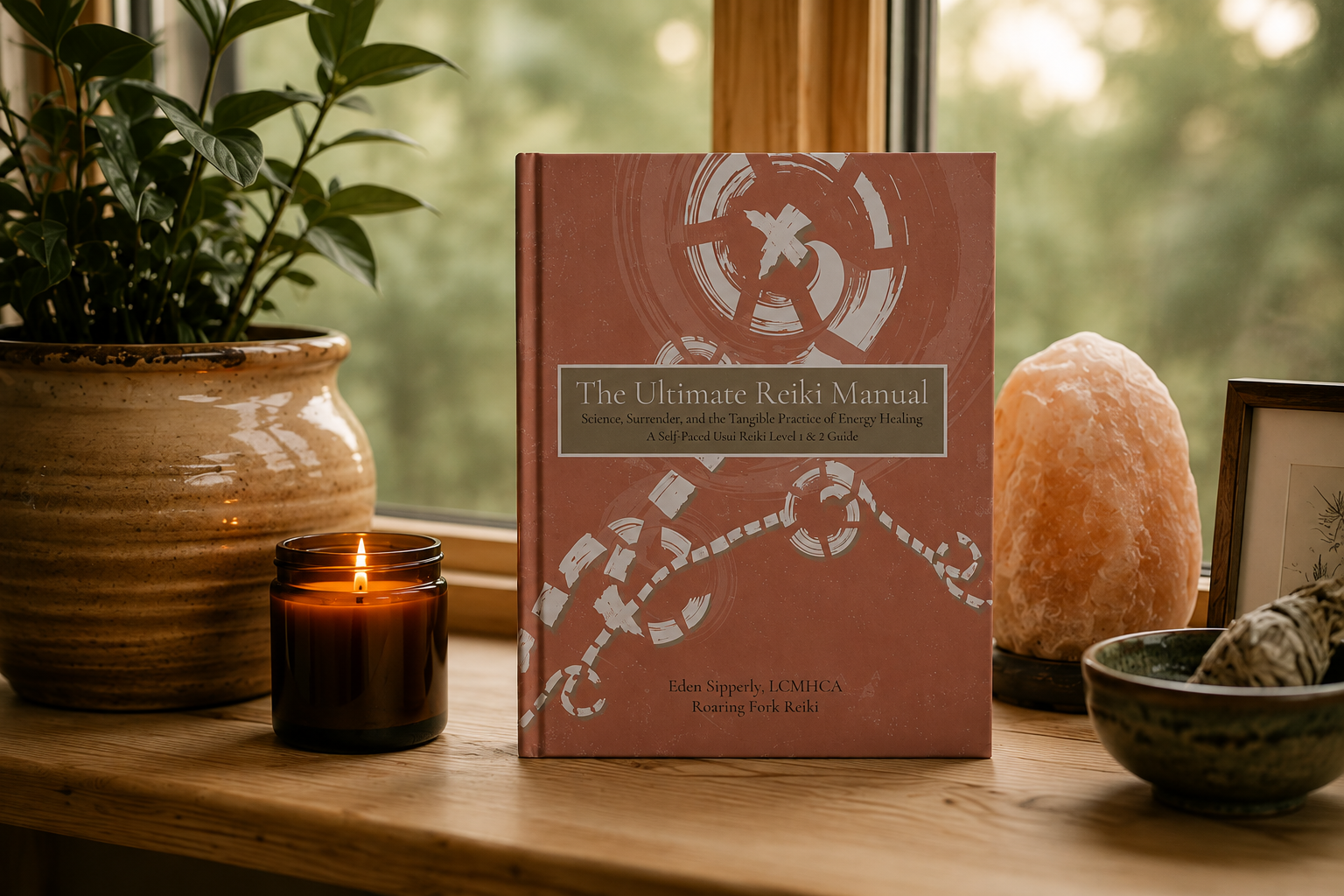
When I created The Ultimate Reiki Manual: A Self-Paced Usui Reiki Level 1 and 2 Guide for You to Explore Science, Surrender, and the Tangible Art of Energy Healing, I kept returning to a different question:
What would I actually want someone to understand before they put their hands on another human being?
That question created a very different kind of Reiki training.
Learning the Technique Is Only the Beginning
There is a difference between knowing how to perform Reiki and developing yourself as a Reiki practitioner.
You can memorize where your hands go.
You can memorize the symbols.
You can learn a sequence for beginning and ending a session.
But what happens when someone begins crying underneath your hands?
What happens when your intuition tells you something about a client?
How do you distinguish intuition from projection?
What if someone has experienced trauma and doesn't want to be touched?
What if a client tells you they want Reiki instead of medical treatment?
What happens when something arises that is simply outside your scope?
And perhaps an even more important question:
Who are you when you are sitting in the practitioner's chair?
You bring your history into the room.
Your beliefs.
Your nervous system.
Your assumptions.
Your relationship with spirituality.
Your biases.
Your fears.
Your intuition.
Your desire to help.
None of those things disappear simply because you learned Reiki.
A comprehensive training should help you become aware of them.
Ethics Are Part of Energy Work
Ethics can sound like the least mystical chapter in a Reiki course.
I think it may be one of the most sacred.
When another person trusts you with their body, emotions, vulnerability, and sometimes their spiritual experiences, your responsibility extends far beyond knowing the correct hand positions.
You need to understand consent, boundaries, scope of practice, confidentiality, appropriate touch, power dynamics, contraindications, and when another form of professional support may be more appropriate.
Good intentions are important.
But good intentions are not the same thing as good practice.
This becomes particularly important in intuitive work. If I experience an image, sensation, thought, or feeling while offering Reiki, that experience belongs first to me.
It may be meaningful.
It may be intuition.
It may also be memory, association, imagination, projection, or my nervous system responding to something subtle in the environment.
A responsible practitioner learns how to hold that uncertainty.
Rather than saying, "I know what your body is telling me," we learn to say, "This came up for me. I'm curious whether it means anything to you."
That small shift returns authority to the person receiving the session.
And that is an ethical practice.
Contraindications Matter, Too
Reiki is often described as universally safe because it is gentle and noninvasive.
But responsible practice still requires discernment.
There are circumstances in which touch may be inappropriate. There are situations involving physical or psychological health where additional caution, modification, referral, or collaboration may be necessary. There are also moments when a practitioner's own competence or scope simply does not match what a client needs.
A Reiki practitioner should know how to recognize those moments.
I don't believe discussing contraindications makes Reiki frightening.
I believe it makes Reiki professional.
We don't diminish the beauty of a practice by acknowledging its boundaries.
Boundaries are part of what makes a container safe enough for surrender.
Your Intuition Needs Somewhere to Practice
One of my biggest frustrations with some Reiki education is how often intuition is discussed as though it simply arrives fully formed after attunement.
"Trust your intuition."
Beautiful advice.
But...how?
How does intuition feel in your body?
Does your intuitive "yes" feel expansive, warm, still, visual, verbal, or something completely different?
How does anxiety feel?
How does projection feel?
How does imagination feel?
What happens when you are wrong?
What happens when you feel nothing at all?
This is why The Ultimate Reiki Manual includes more than 50 guided meditations and experiential practices.
You are not simply told to become intuitive.
You practice paying attention.
You work with imagination, sensation, embodiment, energetic awareness, meditation, mental steadiness, and self-inquiry.
Because intuition is less like downloading an answer and more like learning an instrument.
At first, every sound can feel significant.
With practice, you begin recognizing tone.
Rhythm.
Patterns.
Subtle differences.
Eventually, you learn the particular instrument you are playing.
In Reiki, that instrument happens to be you.
Science Belongs in the Conversation
Another distinction within my approach to Reiki education is that I don't believe spirituality and science need to be kept in separate rooms.
The manual explores the nervous system, neuroscience, embodiment, perception, trauma-informed care, co-regulation, relevant scientific theories, and quantum physics alongside traditional Reiki teachings and energetic anatomy.
Not because science has definitively explained every mechanism proposed within Reiki.
It hasn't.
And I think acknowledging that matters.
Instead, science gives us additional language for exploring some of what humans experience during contemplative, relational, embodied, and energy-based practices.
Understanding the nervous system can deepen our understanding of relaxation.
Understanding interoception can change how we think about intuition.
Understanding co-regulation can illuminate what happens when two people become quiet together.
Understanding perception can make us more thoughtful about the information we believe we are receiving.
Science does not have to remove mystery from Reiki.
Sometimes it simply gives us more interesting questions to ask.
Your Unique Lens Isn't Something to Train Out of You
Perhaps the most important difference in this manual is that I don't want you to become my kind of Reiki practitioner.
I want you to discover yours.
Traditional frameworks are useful. Lineage matters. History matters. Foundational practices matter.
But you are also arriving with an entire lifetime of experience.
Maybe you are deeply spiritual.
Maybe you're skeptical.
Maybe you're a therapist, yoga teacher, nurse, artist, parent, massage therapist, coach, scientist, or someone who has never considered yourself a "healer" at all.
Maybe you see colors when you meditate.
Maybe you feel physical sensations.
Maybe you receive words.
Maybe you experience Reiki as prayer.
Maybe your experience is quieter and far less dramatic.
Your Reiki practice does not need to look exactly like mine in order to be meaningful.
In fact, I would rather teach you how to become curious about your own experience than teach you how to imitate someone else's.
Self-Inquiry Is Part of Practitioner Development
Before we interpret another person's energy, it is helpful to become intimately familiar with our own.
What are you carrying today?
What subjects activate you?
Where do you feel anxiety in your body?
What kinds of people make you want to rescue them?
When do you become uncomfortable with silence?
How badly do you want your intuition to be "right"?
What happens inside you when someone rejects an observation you make?
These may sound more like therapy questions than Reiki questions.
I think they're both.
Self-inquiry helps us recognize where our experience ends and another person's begins.
The clearer that boundary becomes, the more responsibly we can practice intuitive and energetic work.
A Manual That Asks You to Participate
This is why The Ultimate Reiki Manual isn't designed to be something you simply read from beginning to end.
It is something you interact with.
Throughout the training you'll encounter 50+ guided meditations, 40+ real-life case studies, journal prompts, reflection pages, scientific theories, traditional Reiki teachings, Reiki symbols and hand positions, energetic anatomy, nervous system education, trauma-informed practices, ethics, contraindications, and business considerations.
Some pages teach.
Others ask you to stop reading.
Close your eyes.
Try something.
Notice.
Write.
Question.
Practice.
Come back.
Because information can teach you about Reiki.
Experience is what begins teaching you about your Reiki.
Self-Paced Doesn't Have to Mean Unsupported
There is also an important distinction between self-paced and alone.
One of the reasons I created this manual was to give people the freedom to move slowly.
You don't have to understand intuition by Sunday afternoon because the training ends at 5:00.
You can spend longer with something that challenges you.
Repeat a meditation.
Practice Reiki on yourself.
Journal.
Try again.
Notice what changes.
And when you've worked your way through the manual, your training includes one-on-one support with me upon completion.
That gives us space to talk about what arose during your practice, answer lingering questions, explore areas where you feel uncertain, and help you think about what your Reiki practice might look like moving forward.
Because a certificate can mark the completion of coursework.
A conversation can help you integrate what you've actually learned.
Certification Should Be a Beginning
At the completion of the training requirements, you will have a pathway toward Usui Reiki Level 1 and Level 2 certification and a foundation for deciding what comes next.
Maybe Reiki remains entirely personal.
You use it during meditation.
You practice on yourself when you're anxious.
You offer Reiki to your partner, friends, or family.
Maybe it becomes woven into another professional practice where appropriate and within your scope.
Or perhaps you eventually decide to create a Reiki business of your own.
There is no single correct destination.
The point is that when you arrive there, you haven't simply memorized what someone else told you Reiki should feel like.
You've spent time discovering what it feels like through you.
Reiki Is Simple. Holding Space for Humans Isn't.
At its heart, Reiki can be remarkably simple.
Presence.
Attention.
Intention.
Hands.
Breath.
Energy.
But the moment we invite another human being into that practice, we also invite in nervous systems, histories, boundaries, beliefs, trauma, expectations, emotions, vulnerability, and uncertainty.
That deserves more than memorization.
It deserves curiosity.
It deserves ethics.
It deserves practice.
It deserves self-reflection.
And it deserves enough humility to recognize that becoming a practitioner isn't about learning to have all the answers.
Sometimes it is about becoming comfortable enough with uncertainty that you can listen without immediately needing to decide what something means.
The Ultimate Reiki Manual was created to give you the structure to learn the practice—and enough space within that structure to discover the practitioner who is uniquely you.

3 Relaxing Breath Patterns Meditation
Discover three simple breathing techniques designed to calm the nervous system and invite greater relaxation. Each breath pattern offers a practical tool you can return to during moments of stress, anxiety, or overwhelm. Through gentle guidance, you'll experience how intentional breathing can quickly shift your mental and physical state. A perfect practice for daily stress relief and emotional balance. This meditation is one of many you’ll find in my published Reiki Manual to learn Level 1 and 2 Reiki through the lens of science and surrender. This meditation is 12 minutes long, and was written and narrated by Eden Sipperly, Reiki Master Teacher and Licensed Clinical Mental Health Counselor Associate.
More Than a Reiki Manual: A Self-Paced Exploration of Science, Surrender, and Energy Healing
More Than a Reiki Manual: A Self-Paced Exploration of Science, Surrender, and Energy Healing
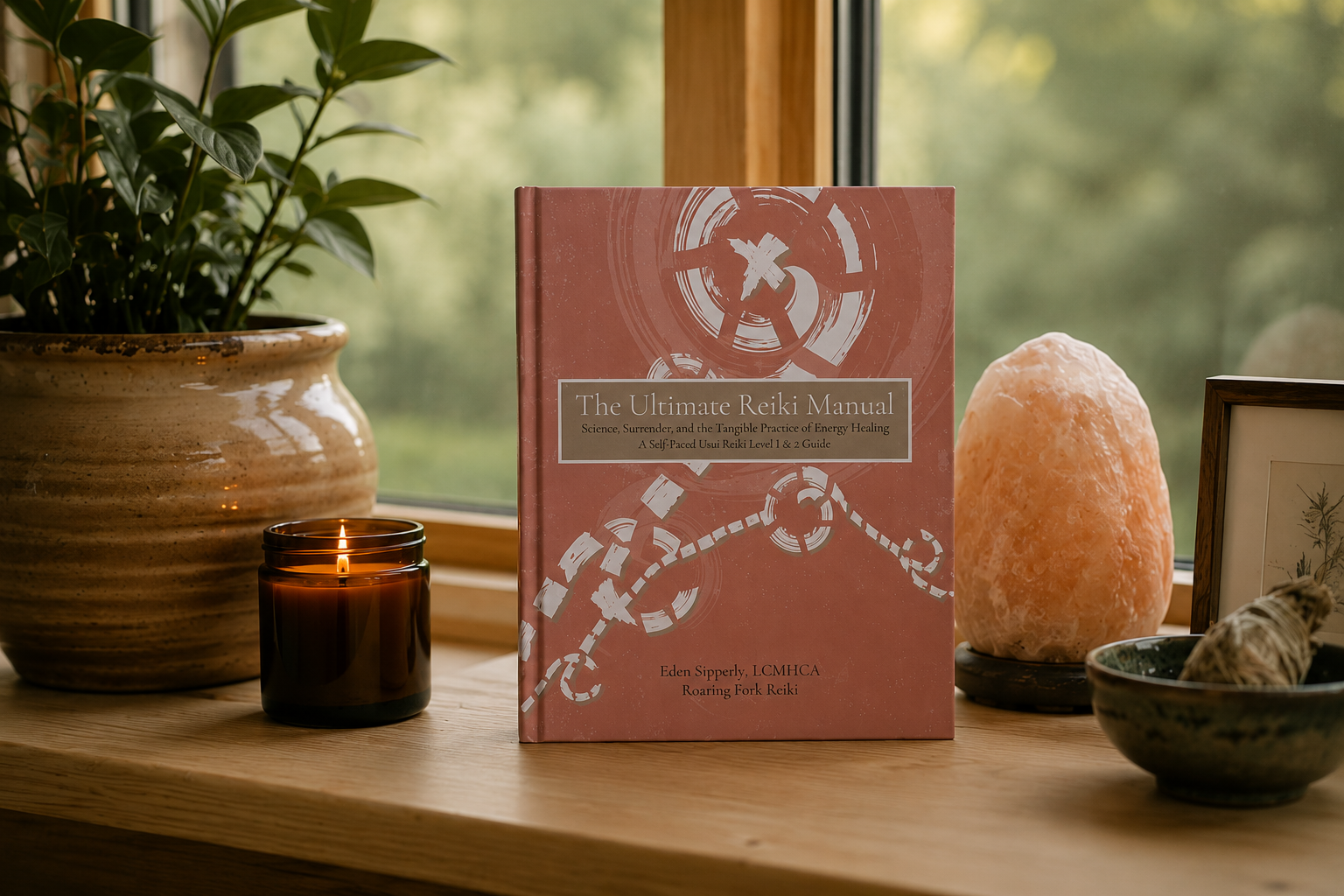
When I began creating The Ultimate Reiki Manual: A Self-Paced Usui Reiki Level 1 and 2 Guide for You to Explore Science, Surrender, and the Tangible Art of Energy Healing, I knew I didn't want to write another book that simply told you where to put your hands.
You can Google a hand position.
You can memorize a symbol.
You can learn the traditional language of Reiki and recite its history.
But becoming a practitioner—someone who can sit with another human being, listen to their own intuition, understand the nervous system, recognize the boundaries of their scope, and become comfortable with the intangible—requires something different.
It requires practice.
It requires curiosity.
And, perhaps most importantly, it requires developing a relationship with yourself.
That is the book I wanted to create.
Reiki Is Something We Practice, Not Just Something We Learn
There is an interesting paradox within Reiki.
On one hand, Reiki is remarkably simple. We slow down. We become present. We place our hands on or near the body. We pay attention.
On the other hand, what emerges from that simplicity can become incredibly nuanced.
How do I know what I'm sensing?
Is this intuition, imagination, projection, or anxiety?
What happens when I don't feel anything?
What does science actually say about energy?
How do I work with someone who has experienced trauma?
When should Reiki not be offered?
How do I trust myself without assuming that everything I intuit is objectively true?
And how do I take something as subtle as energy work and practice it in a way that is grounded, ethical, and tangible?
These are the questions that interest me.
And they became the foundation of The Ultimate Reiki Manual.
A Reiki Education That Includes the Nervous System
If we are going to work with human beings, I believe we should understand something about human bodies.
That means Reiki education can benefit tremendously from conversations about the nervous system, stress responses, embodiment, trauma, consent, co-regulation, and the ways our bodies interpret safety.
The manual explores these intersections throughout the training.
You will learn about the nervous system alongside energy systems.
Trauma-informed care alongside hand positions.
Ethics and contraindications alongside intuition.
Because I don't see these subjects as competing with the spiritual dimensions of Reiki.
I see them as grounding them.
Understanding physiology does not make an experience less sacred.
Sometimes understanding how much the body is doing beneath our conscious awareness makes it even more extraordinary.
Science Without Needing Science to Prove Everything
The manual also explores relevant scientific theories that can help us think differently about the realities and possibilities of energy work.
That includes conversations about neuroscience, perception, the nervous system, embodiment, and even quantum physics.
I am intentional about the word explore here.
Science is most useful when we allow it to be science—not when we stretch fascinating theories beyond what the evidence can actually support in an attempt to make spirituality sound legitimate.
I don't believe Reiki needs a lab coat put on top of it in order to be meaningful.
Instead, science can give us additional lenses.
It can help us ask better questions.
It can show us that the human experience is already filled with invisible processes, electrical activity, prediction, perception, synchronization, biological rhythms, and forms of communication that most of us rarely stop to consider.
The goal isn't to use science to eliminate mystery.
It is to become more thoughtful within it.
50+ Guided Meditations: Because Intuition Requires Practice
One of the largest differences between this manual and a traditional Reiki handbook is that you won't simply be reading.
You'll be practicing.
The book includes more than 50 guided meditations, intentionally created to help you explore and strengthen:
intuition and discernment
awareness of your own energy
energetic channels and energy systems
Reiki practice
embodiment and interoception
imagination and visualization
presence and mental steadiness
your relationship with receiving, surrender, and trust
Why so many meditations?
Because intuition is difficult to learn conceptually.
Imagine trying to teach someone what a strawberry tastes like without allowing them to eat one.
You could describe sweetness. Acidity. Texture. Aroma.
But eventually, they have to taste the strawberry.
Intuition is similar.
You can read about intuitive development indefinitely, but eventually you have to close your eyes, become quiet, notice what arises, and begin learning the difference between your own internal signals.
The meditations create a laboratory within your own body.
You become both the experiment and the observer.
More Than 40 Real-Life Case Studies
Energy work can become abstract very quickly.
That's why The Ultimate Reiki Manual includes more than 40 case studies drawn from real-life client experiences.
These stories help bridge the space between learning a concept and understanding how it might actually show up when another person is lying on your Reiki table.
Because people are complicated.
One client may experience warmth.
Another may see imagery.
Another may cry unexpectedly.
Another may fall asleep.
Someone may feel absolutely nothing during their session and recognize a meaningful shift several days later.
Case studies allow us to explore those differences without turning them into rigid formulas.
They also reinforce something I believe is essential to ethical intuitive work:
The practitioner does not get to be the ultimate authority on someone else's experience.
We can notice.
We can become curious.
We can offer observations carefully.
But the person receiving Reiki remains the expert on what their experience means.
The Reiki Essentials Are Here, Too
Of course, exploration requires a foundation.
The manual provides comprehensive instruction in the traditional essentials of Usui Reiki Level 1 and Level 2, including Reiki prayers and principles, hand positions, Reiki symbols, attunement, and knowledge of energy systems and energetic anatomy.
You'll explore the foundational practices that have shaped Reiki while also being encouraged to develop a practice that becomes genuinely embodied rather than simply memorized.
Tradition gives us the container.
Practice teaches us how to inhabit it.
Trauma-Informed Reiki, Ethics, and Contraindications
Learning how to offer Reiki also means learning when to pause.
The manual includes dedicated education around trauma-informed care, ethics, consent, professional boundaries, contraindications, and responsible practice.
For me, this isn't supplementary material.
It is Reiki training.
If we are inviting someone into a vulnerable experience—lying down, closing their eyes, receiving touch or near-body work, potentially experiencing emotion—we need to understand that safety cannot simply be assumed because our intentions are good.
Intent matters.
Impact matters, too.
A grounded Reiki practitioner learns to respect both.
From Reiki Practice to Reiki Business
For some readers, this book will remain deeply personal.
You may learn Reiki because you want another way to care for yourself.
You may practice with your partner, your children, friends, family members, plants, animals, or simply your own body.
For others, something larger may begin taking shape.
You might realize:
I want to offer this to people.
The manual therefore also includes education around business practices and the practical considerations involved in moving from personal Reiki practice toward offering sessions professionally.
Because if your spirituality eventually becomes a business, spreadsheets, policies, scheduling, communication, boundaries, and professionalism become part of the spiritual practice, too.
There is something beautifully grounding about that.
A Book You Are Supposed to Write In
This isn't intended to be a pristine book that lives untouched on a shelf.
Write in it.
Underline things.
Disagree with me.
Circle something that gives you chills.
Come back six months later and realize you interpret a passage completely differently.
Throughout the manual you'll find journal prompts, inspirational quotes, and dedicated pages for reflection and integration.
Because your responses matter.
Reiki is not about replacing your knowing with someone else's.
It is about developing a relationship with your own.
From Curiosity to Reiki Certification
The manual is designed as a self-paced Usui Reiki Level 1 and Level 2 training, meaning you can move through the material according to your own rhythm rather than trying to absorb an entire energetic practice over a hurried weekend.
Read.
Practice.
Meditate.
Journal.
Try Reiki on yourself.
Notice.
Come back.
Practice again.
Upon successfully completing the required training components, the manual provides a pathway toward Reiki Level 1 and Level 2 certification, equipping you with a foundation from which you can continue practicing Reiki for yourself, share Reiki with friends and family, or begin developing a professional Reiki practice of your own.
The goal isn't simply to finish the last page.
It is to arrive there differently than you began.
Science, Surrender, and the Tangible Art of Energy Healing
I chose those three ideas intentionally.
Science asks us to stay curious.
Surrender asks us to loosen our grip on needing to understand everything.
And practice turns something intangible into something we can actually experience.
There is room here for skepticism.
There is room for spirituality.
There is room for the nervous system and the chakra system, neuroscience and intuition, evidence and mystery.
You don't have to abandon one part of yourself to explore another.
In fact, I think Reiki becomes most interesting when we stop asking ourselves to choose between them.
The Ultimate Reiki Manual is ultimately an invitation to explore that middle ground—to learn the traditions of Reiki, understand the body you're practicing within, strengthen your intuition through experience, and discover what happens when you become quiet enough to notice what has been there all along.
You don't have to believe everything.
You do have to become curious enough to practice.